As parents or those in a parenting role, you play an important role in your child’s success. There are intentional ways to grow a healthy parent-child relationship, and helping your six-year-old learn to deal with tantrums constructively provides a perfect opportunity.
Children ages five to ten are in the process of learning about their strong feelings. They do not understand the full-body takeover that can occur when angry, hurt, or frustrated. A sense of a lack of control can be scary and add to the length and intensity of their upset.
Tantrums and meltdowns can be overwhelming for children and the adults in their lives. Learning how to deal with anger or upset without choosing destructive responses is critical. Understanding the difference between a tantrum and a meltdown will help parents and those in a parenting role properly guide their children through these intense times. Your support and guidance matter greatly.
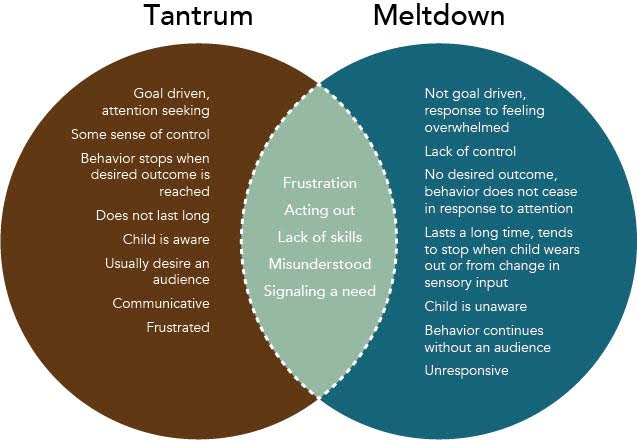
Even though they may look like the same behaviors, tantrums and meltdowns are different and require different approaches to handle each.
Tantrums are
a typical reaction or outburst to feeling anger or frustration
a cry for attention or an inability to communicate
within a child’s scope of awareness and control
goal-oriented
A child throwing a tantrum is experiencing intense feelings and acting out in hopes of a desired outcome. Sensory meltdowns, like tantrums, are characterized by a child experiencing big feelings, but the difference is that the child is not acting out in search of a desired outcome.
Meltdowns are
most common among children with sensory processing disorders, autism, or other medical issues who are easily overstimulated or cannot cope with emotional triggers such as fear or anxiety
an instinctive survival reaction to being overstimulated or feeling distressed
not goal-oriented, meaning they are not affected by a reward system
long-lasting
children may never grow out of them like they do tantrums
To a parent or someone in a parenting role, tantrums and meltdowns may seem like mischievous behaviors that the child needs to curb immediately. However, it is critical to remember that these outbursts are a child’s attempt to communicate something about their intense feelings. Parents and those in a parenting role can help guide their children through these feelings and teach them skills to manage them.
Parents’ recognition and understanding of tantrums and meltdowns are essential for teaching children how to recognize and handle their big feelings.
This tool is most applicable to parents handling children with tantrums. While many of the strategies for tantrums help children experiencing meltdowns, it is essential to note that meltdowns require immense patience, calm, and presence of mind to keep children safe. There are many helpful resources for parents of children with sensory processing challenges. A few resources about sensory meltdowns include:
The Autism Speaks website has multiple articles and information on meltdowns. A simple search of “meltdowns” in the search bar brings up numerous options. https://www.autismspeaks.org/
National Autistic Society, an organization in the United Kingdom, has a website that also provides multiple articles on meltdowns and dealing with anger and anxiety when “meltdowns” are searched. https://www.autism.org.uk/
Research confirms that when children learn to manage their feelings, their executive functions are simultaneously strengthened.1 They can better use self-control, problem-solve, and focus their attention, directly impacting their school success.
The key to many parenting challenges, like tantrums, is finding ways to communicate to meet your and your child’s needs. The steps below include specific, practical strategies and effective conversation starters to prepare you to help your child work through their roughest, most intense emotional times in ways that build up their resilience and self-management skills.
Why Tantrums?
Whether your five-year-old is frustrated over trying to put on shoes by themselves or your ten-year-old stays up late angry that a friend refused to play with them, learning how to deal with anger, upset, and their many accompanying feelings can become a regular challenge if you don’t create plans and strategies for managing them.
Today, in the short term, learning to manage tantrums can create
a sense of confidence that you can help your child regain calm and focus
a greater opportunity for connection and enjoyment as you work together to care for each other
trust in each other that you have the competence to manage your intense feelings
added daily peace of mind
Tomorrow, in the long term, your child
builds skills in self-awareness
builds skills in self-control and managing emotions
learns independence, life skills competence, and self-sufficiency
builds assertive communication to communicate needs and boundaries, which are critical for keeping them safe and ready to deal with peer pressure
Five Steps for Managing Tantrums
This five-step process helps you and your child manage tantrums and builds important skills in your child. The same process can also be used to address other parenting issues (learn more about the process).
Tip: These steps are best when you and your child are not tired or in a rush.
Step 1 Get Your Child Thinking by Getting Their Input
You can get your child thinking about ways to constructively manage their most upsetting feelings by asking them open-ended questions when they are calm. You’ll help prompt your child’s thinking. You’ll also better understand their thoughts, feelings, and challenges related to managing their intense feelings so that you can address them. In gaining input, your child
has the opportunity to become more aware of how they are thinking and feeling and understand when the cause of their upset is anger-related
can think through and problem-solve any challenges they may encounter ahead of time
has a greater stake in anything they’ve thought through and designed themselves, and with that sense of ownership comes a greater responsibility for implementing new strategies
will have more motivation to work together and cooperate because of their sense of ownership
will be working with you on making decisions (and understanding the reasons behind those decisions) about critical aspects of their life
Actions
Be curious about your child’s feelings. You might start by asking:
“When do you feel angry or intensely upset?”
“What time of day?”
“What people, places, and activities are usually involved?”
Use your best listening skills. Remember, what makes a parent angry can differ significantly from what angers a child. Listen closely to what concerns your child most without projecting your thoughts, concerns, and feelings.
Explore the mind-body connection. In calmer moments with your child, ask, “How does your body feel now?” See how descriptively they can list their physical signs of well-being. Now ask, “How does your body feel when angry?” Every person’s physical experience will be different. Find out how your child feels and make the connection between those symptoms and the usual feelings they are having.
Resist the urge to provide solutions. Your curiosity and questions will go much farther in helping your child feel heard and helped.
Tip: If your child has recently thrown a tantrum, use that example to reflect on what caused it at a time when you are both calm. You might ask, “What upset you after school yesterday?” Finding out what contributed to a tantrum can give you insight into your child’s triggers and also help raise your child’s self-awareness.
Step 2Teach New Skills
Because intense feelings like anger and hurt occur as you go about your daily life, you may not consider their role and impact on your child, though it can have a major influence on their day and your relationship with them. Learning about what developmental milestones a child is working on can help you better understand what your child is going through and what might be contributing to anger or frustration.2
Five-year-olds are working hard to understand how things work, so they tend to ask lots of questions and appreciate explanations. They may have a hard time seeing others’ perspectives. They are working hard to understand rules and may be upset or disappointed when they do not understand a rule or find it challenging to show competence. They may get angry if they break a rule or see others breaking it. They are also beginning to test rules as they move from five to six, which can prompt a parent’s anger.
Six-year-olds can feel anxious as they want to do well in school and at home. They may be highly competitive and criticize peers while being sensitive to being criticized themselves. They care about friendships and may experience upset feelings related to those relationships.
Seven-year-olds need consistency and may get angry and feel out of control when chaotic schedules and routines change. They may be moody and require reassurance from adults. They take school and homework seriously and may even feel sick from worrying about tests or assignments. They can take academic failure personally, get angry, and push away or neglect their work to avoid more failure.
Eight-year-olds are interested in and invested in friendships. Peer approval becomes as important as their teacher’s approval. Peer approval can upset them when friends reject them. They are more resilient when they make mistakes. They have a greater social awareness of local and world issues and may be concerned about the news or events outside of their community.
Nine-year-olds can be highly competitive and critical of themselves and others. They may worry about who is in the “in” and “out” crowds and where they fit in friendship groups. They may tend to exclude others to feel included in a group, so it’s an excellent time to encourage inclusion and kindness toward a diverse range of others. They are just beginning puberty. They will be experiencing growth spurts and the associated clumsiness and awkwardness. Anger can be generated from rejection or judgment from peers.
Ten-year-olds have an increased social awareness and try to figure out the thoughts and feelings of others. With this awakening comes a newfound worry about what peers think of them (for example, “He’s staring at me. I think he doesn’t like me.”). They can become angered if they feel judged, even if they are not making accurate predictions of peers’ feelings. They also seek more independence from parents and those in a parenting role, so they can get angry when parents treat them as they were in their younger years or make them feel dependent (taking some of their power away).
Teaching is different than just telling. Teaching builds basic skills, grows problem-solving abilities, and prepares your child for success. Teaching also involves modeling and practicing the positive behaviors you want to see, promoting skills, and preventing problems.
Actions
Learn together! Anger and hurt are essential messages to pay attention to. They mean emotional, social, or physical needs are not met, or necessary boundaries (rules, values) are violated. It’s important to ask: “Why am I feeling this way? What needs to change to feel better?”
Respond with emotional intelligence. When your child has a tantrum, focus on calming yourself down and then your child. Stop what you are doing and walk them to a safe, non-public spot where they can calm down. Don’t leave them. Be with them and use a calm, soft voice, encouraging them to breathe by breathing with them slowly. Don’t try to talk about the situation until they are calm (they won’t be able to hear you anyway). Stand aside and focus on your deep breathing while you allow your child time to calm down.
Brainstorm coping strategies. You and your child can use numerous coping strategies depending on what feels right. But, when you are angry and upset, recalling what will make you feel better can be difficult. That’s why brainstorming a list, writing it down, and keeping it ready can come in handy when your child needs it. Here are some ideas from Janine Halloran: 3 Imagine your favorite place, take a walk, drink water, take deep breaths, count to 50, draw, color, and build something.
The saying, “Name it to tame it,” really works! Look for ways to identify feelings and name them. Post this feelings chart on your refrigerator as a helpful reminder. The more you can name a range of feelings in family life, the more comfortable your child will get with saying what they are feeling. This strategy alone can reduce the time a child is engaged in a tantrum since they become skilled at saying what they are feeling and feel more capable of securing their understanding faster.
Create a calm-down space. During playtime or time without pressures, design a “safe base” or place where your child decides they would like to go when they are upset to feel better. Maybe their calm-down space is a beanbag chair in their room, a blanket, or a special carpet in the family room. Then, think together about what items you might place there to help with the calm down.
Reflect on your child’s anger so you can be prepared to help. When reflecting on your child’s feelings, you can think about unpacking a suitcase. Frequently, layers of feelings need to be examined and understood, not just one. Anger might just be the top layer. So, after discovering why your child was angry, you might ask about other layers. Was there hurt or a sense of rejection involved? Perhaps your child feels embarrassed? Fully unpacking the suitcase of feelings will help your child feel better understood by you as they become more self-aware. Ask yourself:
“What needs is my child not getting met?” They might need a friend to listen, some alone time, or to escape a chaotic environment.
“Can my child address the issue alone, or do they need to communicate a need, ask for help, or set a boundary?” One of the hardest steps for many can be asking for help or drawing a critical boundary line when needed. You’ll need to help your child identify the issues in your reflections. But then, guiding them to communicate their needs is key.
Help your child repair harm when needed. A critical step in teaching your child about managing anger is learning how to repair harm when they’ve caused it. Mistakes are an essential aspect of their social learning. Everyone has moments when they hurt another. But, it’s that next step that they take that matters in repairing the relationship.
Find small opportunities to help your child repair relationships. Siblings offer a regular chance to practice this! If there’s fighting, talk to your child about how they feel first. When you’ve identified that they had a role in causing harm, brainstorm together how they might make their sibling feel better. You might ask, “What could you do?”
Model repair. If you lose your temper or are extra short with your child and realize that you were taking some stress off the workday out on them, let them know. Some parents may believe that apologizing may undermine their authority. However, making repairs helps to strengthen trust in your relationship with your child. You may say, “Hey, I realized I snapped at you in the kitchen. I’m sorry. I had a stressful day, and I think I accidentally took that out on you. That’s not okay, and I am going to work on it. I’m going to take 5 min to cool down and take care of myself so I can come back and be present with you.”
Tantrums occur at any age. Though you may not call it a tantrum beyond toddler or preschool age, children, teens, and adults can emotionally lose control.
Expressing anger in a manner like yelling will not dissipate it. Research confirms that the expression of aggression, whether it’s yelling or hitting (and that includes hitting, yelling, or spanking by parents), exacerbates the anger.1
Avoiding or pretending you are not angry will not make it disappear in time. Because anger—like any other feeling—emerges to send a vital message to its owner, it cannot be avoided or denied. When turned inward, anger can become destructive in the body. Also, when buried anger can be stuffed down for a time, it may contribute to a larger explosion (that may not have occurred otherwise) because of the buildup of heated feelings over time.
Tip: Raising your voice and your level of upset in response to your child’s tantrum will only increase the intensity and duration of your child’s upset. Yelling only communicates that you are raising the emotional intensity, not diminishing it. Leaving your child alone in their room will also escalate the tantrum at this age. They need you, and they may be fearful of themselves because their feelings have overpowered them.
Tip: The only way a calm-down space serves as a tool for parents to promote their children’s self-management skills is if they allow a child to self-select the calm-down space. Practice using it and gently remind them of it when they are upset. “Would your calm down space help you feel better?” you might ask. But if that space is ever used as a punishment or a directive – “Go to your calm down space!” – the control lies with the parent and no longer with the child, and the opportunity for skill building is lost.
Step 3Practice to Grow Skills and Develop Habits
Practice is necessary for children to internalize new skills. Practice can be pretend play, cooperatively completing the task together, or trying out a task with you as a coach and ready support. Practice grows vital new brain connections that strengthen (and eventually form habits) each time your child manages their intense feelings.
The practice also provides essential opportunities to grow self-efficacy — a child’s sense that they can manage their feelings successfully.
Actions
Use “Show me…” statements with a positive tone and body language to express excitement and curiosity. When a child learns a new ability, they are eager to show it off! Give them that chance. Say, “Show me how you use your safe base to calm down.” This can be used when you observe their upset mounting.
Recognize effort by using “I notice…” statements like, “I noticed how you took some deep breaths when you got frustrated. That’s excellent!”
Accept feelings. If you will help your child become emotionally intelligent in managing their biggest feelings, it is important to acknowledge and accept their feelings — even ones you don’t like! When your child is upset, consider your response. You could say, “I hear you’re upset. What feels most supportive when you’re upset?”
Practice deep breathing. Because deep breathing is such a simple practice that can assist your child anytime, anywhere, it’s important to get plenty of practice to make it easy to use when needed. Here are some enjoyable ways to practice together!4
Teddy Bear Belly Breathing. Balance a teddy bear on your child’s tummy and give it a ride with the rising and falling of their breath. This would be ideal to practice during your bedtime routine when you are lying down and want to calm down for the evening.
Blowing Out Birthday Candles Breathing. You can pretend you are blowing out candles on a birthday cake. Just the image in your head of a birthday cake brings about happy thoughts. And, to blow out several small flames, you must take deep breaths.
Include reflection on the day in your bedtime routine. You might ask, “What happened today that made you happy?” or “What were the best moments in your day?” You should answer the questions as well. Children may not have the chance to reflect on what’s good and abundant in their lives throughout the day. Grateful thoughts are a central contributor to happiness and well-being.
Reflect and reframe. When you are reflecting with your child about their upset, it can be helpful to consider the issue from another perspective. Though you never want to excuse another child’s hurtful behaviors, you can better understand their thoughts and feelings. For example, Julie was cruel to your child today when, on most days, they are joyful friends. You might ask, “It seems like Julie had some big, painful feelings. It is not okay that she took that out on you. I do wonder what may be going on for her. Do you have any ideas? ?” Find out. What if Julie’s parents have recently announced they are getting a divorce? There are always reasons for children’s behavior. See if you can dig further to find compassion and understanding and share that with your child.
Trap: Refrain from judging your child’s friends. You want your child to trust you with their friendship worries and problems. If you harshly judge their friends, they may lose some of that trust and not confide in you.
Step 4Support Your Child’s Development and Success
At this point, you’ve taught your child some new strategies for managing their intensely upset feelings so that they understand how to take action. You’ve practiced together. Now, you can offer support when it’s needed by reteaching, monitoring, coaching, and, when appropriate, applying logical consequences. Parents naturally offer support as they see their child fumble with a situation in which they need help. This is no different.
Actions
Ask key questions to support their skills. For example, “You are going to see Julie today. Do you remember what you can do to assert your feelings?”
Learn about your child’s development. Each new age presents different challenges. Being informed about what developmental milestones your child is working toward will help you be more compassionate and patient.
Stay engaged. Working together on ideas for trying out new and different coping strategies can help offer additional support and motivation for your child when tough issues arise.
Step 5Recognize Efforts
No matter how old your child is, your positive reinforcement and encouragement have a significant impact.
If your child is working to grow their skills – even in small ways – it will be worthwhile to recognize it. Your recognition can go a long way in promoting positive behaviors and expanding your child’s confidence. Your recognition also promotes safe, secure, and nurturing relationships — a foundation for strong communication and a healthy relationship with you as they grow.
There are many ways to reinforce your child’s efforts. It is essential to distinguish between three types of reinforcement: recognition, rewards, and bribes. These three distinct parenting behaviors have different impacts on your child’s behavior.
Recognition occurs after you observe the desired behavior in your child. Noticing and naming the specific behavior you want to reinforce is key to promoting more of it. For example, “You took a deep breath when you got frustrated– that is a great idea!” Recognition can include nonverbal acknowledgment such as a smile, high five, or hug.
Rewards can be helpful in certain situations by providing a concrete, timely, and positive incentive for doing a good job. A reward is determined beforehand so the child knows what to expect. It stops any negotiations in the heat of the moment. A reward could be used to teach positive behavior or break a bad habit. The goal should be to help your child progress to a time when the reward will no longer be needed. If used too often, rewards can decrease a child’s internal motivation.
Unlike a reward, bribes aren’t planned and generally happen when a parent or someone in a parenting role is in a crisis. While bribes can be helpful in the short term to manage stressful situations, they will not grow lasting motivation or behavior change and should be avoided.
Trap: It can be easy to resort to bribes when recognition and occasional rewards are underutilized. If parents or those in a parenting role frequently resort to bribes, it is likely time to revisit the five-step process.
Actions
Recognize and call out when things are going well. It may seem obvious, but it’s easy not to notice when everything moves smoothly. Noticing and naming the behavior provides the necessary reinforcement that you see and value your child’s choice.
Recognize small steps along the way. Don’t wait for significant accomplishments—like the full bedtime routine going smoothly—to recognize effort. Remember that your recognition can work as a tool to promote more positive behaviors. Find small ways your child is making an effort and let them know you see them.
Closing
Engaging in these five steps is an investment that will strengthen your skills as an effective parent or someone in a parenting role on many other issues and develop essential skills that will last a lifetime for your child. Through this tool, children can become more self-aware, deepen their social awareness, exercise their self-management skills, work on their relationship skills, and demonstrate and practice responsible decision-making.
1. National Scientific Council on the Developing Child. (2004). Children’s emotional development is built into the architecture of their brains (Working Paper No. 2). Center on the Developing Child at Harvard University. http://www.developingchild.net
2. Wood, C. (2017). Yardsticks: Child and adolescent development ages 4–14. Turners Falls, MA: Center for Responsive Schools.
This content does not necessarily reflect the views or policies of the Tools for Your Child’s Success communities, financial supporters, contributors, SAMHSA, or the U.S. Department of Health and Human Services.
Explore a step by step process for dealing with simple and challenging parenting topics to build critical life skills and improve your relationship with your child.
We use cookies to ensure that we give you the best experience on our website. If you continue to use this site we will assume that you are happy with it.